
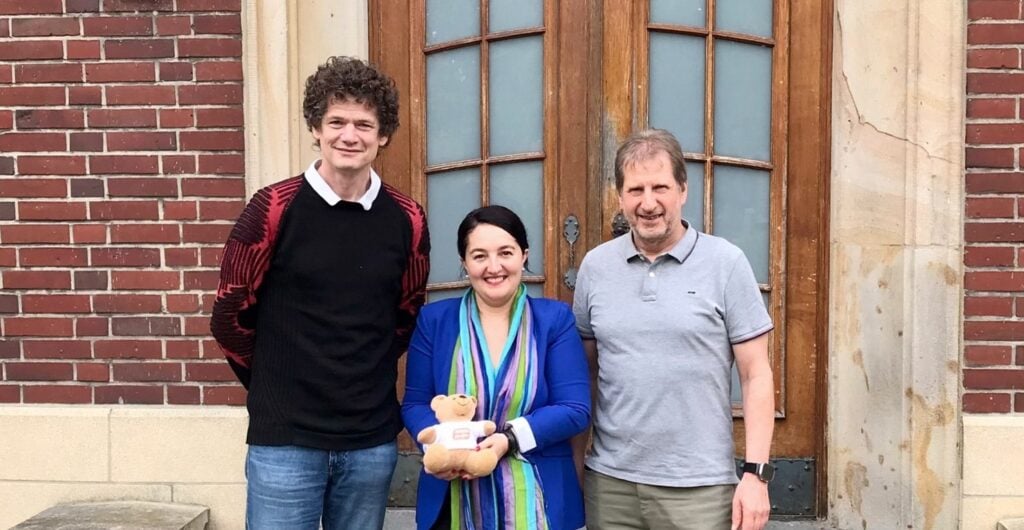
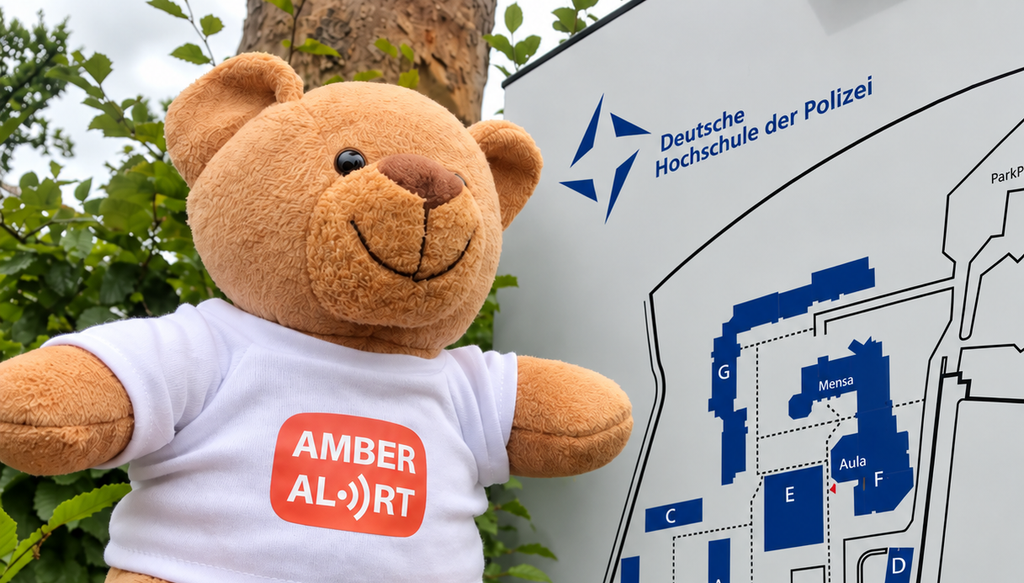
AMBER Alert Europe’s expertise in cold case investigation is now directly contributing to how Germany trains its future police leadership. Karsten Bettels, leader of AAEU’s International Cold Case Analysis Project (ICCAP), co-led a dedicated module on cold cases at the German Police academy (Deutsche Hochschule der Polizei), the country’s central academy for training police officers destined for leadership roles across federal and state forces. AAEU’s Nana Leenaerts, Director for European Affairs, also addressed the audience of future German police commanders on victims’ rights and the latest developments in European legislation.
“The elective module on cold cases, delivered as part of the Master’s programme at the German Police University in collaboration with DHPol and AAEU, once again highlights the interest within police training in Germany in addressing the topic of Cold Cases in an interdisciplinary and international context, taking into account the latest scientific findings and incorporating the victims’ perspective.”Says ICCAP leader Karsten Bettels.
This article is a translation of the original article published in German by the German Police University (Deutsche Hochschule der Polizei, DHPol). The original can be found on the DHPol website.
Cold Cases: Unsolved Crimes at the Centre of Police Training
“We cover every facet of the topic, from investigative questions and new technological insights to media portrayals and the perspectives of victims’ relatives,” says Prof. Dr. Lars Berster, Head of the “Criminal Law, Criminal Procedure and Criminal Policy” department, describing the module’s content. Together with retired Detective Chief Superintendent Karsten Bettels, he led the course for future police officers in leadership roles. Speakers from Germany and abroad took part, and the practical component included the analysis of a real murder investigation file.
Karsten Bettels, a leading expert in cold case investigations and head of the International Cold Case Analysis Project (ICCAP) under AMBER Alert Europe (AAEU), explained what sets cold cases apart from solved cases. His presentation drew on the 63 homicides, missing-persons cases and cases involving unidentified victims already analysed through the project. “If evidence isn’t secured from the very beginning, it can be irretrievably lost — and with it, the chance to solve the case,” Bettels emphasised. Other decisive factors include whether victims could be identified whether they were found at the crime scene or elsewhere, and whether the investigation initially began as a homicide or as a missing-persons case — as was true for 36% of the cases examined.
The module’s organisers therefore aim to raise awareness of the issue of missing persons and crime victims, while also introducing new criminological, psychological and forensic approaches to solving cold cases.
New forensic DNA methods could advance investigations
Innovative forensic techniques such as Forensic Investigative Genetic Genealogy (FIGG) — searching ancestry databases using resequenced, decoded victim DNA — offer expanded possibilities for identification. This was presented by Dr. Pia Jores of the biotechnology company Qiagen, who also pointed to existing concerns about the method’s use, stressing that success sometimes comes down to chance and the sheer persistence of investigators.
Environmental DNA (eDNA) — DNA drawn from the surrounding environment — is opening further avenues. Swabs used to secure human DNA can also carry microbiomes and other environmental DNA traces alongside the actual evidence. This largely untapped information could yield additional leads on a perpetrator or their contact with the environment. Prof. Eran Elhaik of Lund University in Sweden illustrated the forensic potential using the example of a half-eaten apple left behind by a perpetrator at a crime scene: alongside human DNA, such an item can carry other biological traces that open up additional investigative angles — a potential that has yet to be used systematically.
Relatives of victims calls for stronger victims’ rights
Another speaker, Nana Leenaerts, Head of the EU Affairs Department at the Dutch non-governmental organisation AMBER Alert Europe, addressed the audience. The network works across borders and agencies in 29 countries with 100 participating organisations to improve child safety, the search for missing children, and the protection of victims’ rights. She focused in particular on the latest developments in European legislation on victims’ rights and their implications for police authorities during criminal investigations. “Relatives of cold case victims across the entire EU are waiting for closure. AMBER Alert Europe puts the latest evidence-based research findings at the service of law enforcement,” Leenaerts explained, stressing that a society-wide approach is essential.
Natascha Pfau shared her perspective on cold cases as the relative of a murder victim. The daughter of Cornelia Pfau, who was murdered in 1990, released a video in 2023 to bring renewed attention to the case and prompt new investigative leads. Karsten Bettels sought to review the case, but the data protection authority in Baden-Württemberg ruled that the file could not be transferred to Lower Saxony. “We need to talk more about victims’ rights,” Pfau argued. “Right now, data protection takes precedence over victims’ rights.” She also stressed that police must always take relatives seriously, even when they were very young at the time of the crime. She currently places her hope in students at the Baden-Württemberg Police University, who have taken up the case. Television journalist Ralf Döbele spoke about the ZDF programme Aktenzeichen XY… ungelöst. The format regularly revisits cold cases to bring unsolved crimes back into public awareness and appeal to potential witnesses. Its portrayals, based on investigation files, are deliberately emotive. “Using curiosity as a driver is an essential success factor,” Döbele emphasised. The 1983 murder of Lolita Brieger, for instance, was solved as a direct result of a broadcast in 2011.
Systematic cross-agency cooperation is key
“The cases presented in the module show that notable individual successes continue to be achieved in solving decades-old serious crimes,” Lars Berster concluded, while also stressing that “beyond these successes, there remains significant potential for structural improvements in how cold cases are handled.” This includes shared standards for prioritising and reassessing old cases, more intensive communication across agencies and countries, and a more systematic exchange of case information — to which a nationwide cold case register could contribute.
“Raising awareness among future police leaders of the right structures, systematic knowledge transfer and cross-agency cooperation, and equipping them with concrete approaches for their future responsibilities, is a core aim of this elective module.”
For questions, please contact us at: info@amberalert.eu
